
It’s a strange moment to go see a movie like The Long Walk. We’ve always had tales about America descending into a fascist dystopian hellscape where quality of life is determined by chance and the powers that be will stop at nothing to punish those who move even the smallest toe out of line. Something about the current climate makes it hard for me to enjoy sitting down to The Handmaid’s Tale, Fahrenheit 451, or even The Hunger Games. But it has to be said I think that sense of creeping dread made watching Stephen King’s run at the genre play out on screen all the more impactful.
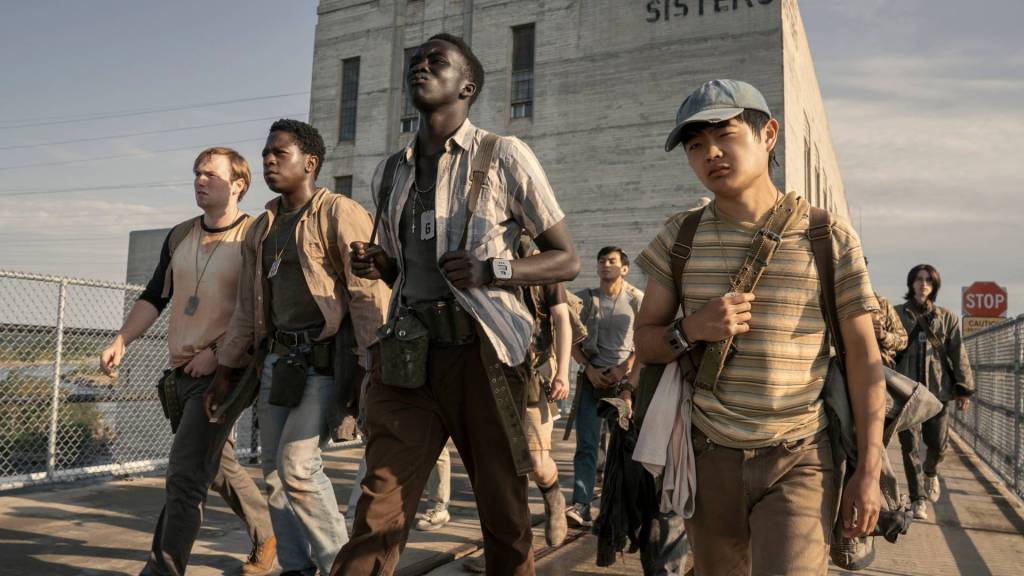
The Long Walk takes place in an alternate but eerily familiar America. Every year, one young man from each of the 50 US states is selected to participate in a walk for as long as they can. Should any participant be unable to sustain a speed of three miles an hour, they are executed until there is only one boy remaining. The movie is centered around Ray Garraty (Cooper Hoffman) as his mom (a tragically underutilized Judy Greer) drops him off for The Walk. It is allegedly voluntary, but it’s pointed out that not much is voluntary in a world where death and disease await at every corner and poverty is the only guarantee the government can provide for you. The winner of The Long Walk becomes insanely wealthy, riches beyond their wildest dreams. He is also granted a wish, anything they choose can be theirs.
The charm of the film comes from the moments during the walk that feel akin to another King work, Stand By Me. Even amidst the darkness there’s a treacly sweetness that is oft found in King stories. Boys coming into adulthood trying to figure out the world around them, and finding strength in one another. Long winded conversations about philosphy of life and what are the good things to be enoyed in a massively imperfect world. The central four boys form a bond as the ones around them are lost. Even as they know the inevitable end to the game, they seek refuge in one another.
The movie’s narrative stems from King’s feelings about the Vietnam draft of the 1970s. Sending boys to die in a needless war, a sacrifice that a country was willing to make for the sake of spreading American idealism. These nationalistic ideals are shouted at the boys as they walk by The Major (Mark Hamill). The Major speaks loudly and without end about how the work they’re doing will inspire the rest of the country. How honorable it is to be senselessly gunned down as their bodies give out from hiking hundreds of miles. Even as he does, Ray’s method of fighting back is one of respect for his fellow enlistees, even if they are his competition.
The cast of young men are all talented, Peter McVries (David Jonsson), Art Baker (Tut Nyuot), and Gary Barkovitch (Carlie Plummer) make up Ray’s gang of friends that lean on one another throughout the film. Jonsson and Hoffman easily give the two best performances in the movie but the whole cast understands the brief. Even as hopeless as the movie seems, it’s nice to see whatever signs of resistance the boys are able to muster against The Major. Their actions contrast against the violent tragedy plays out on screen. The world may be dark, but there will always be someone nearby to help us through it. It’s a regular message from King, and it’s at a time in America that couldn’t feel more poignant.
4/5
 The Joey Awards