
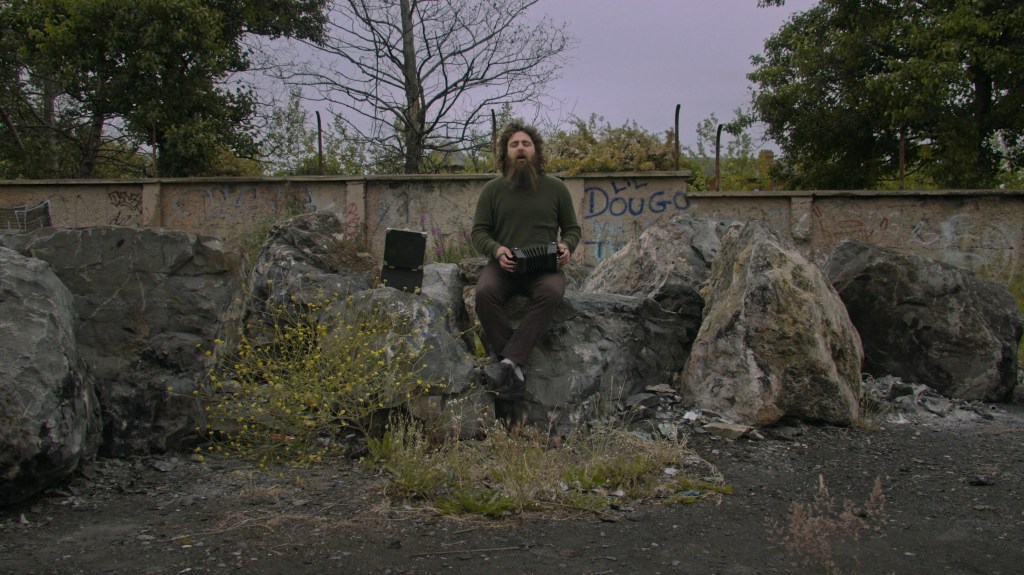
It’s understandable to be concerned while watching Celtic Utopia (perhaps we should be calling it by its Irish name Útóipe Cheilteach) that the film makers are tackling too many subjects. At first it seems like it will simply be happy to show Irish folk musicians The Mary Wallopers lives and showcase some of their music. Then the film starts to talk about the colonialist period of the UK and Irish music’s job as a form of protest. Then the film also starts to wrestle with how Irish pride is inherently tied to Catholicism, and that the progressive views of your average Irish person are not neccessarily aligned with that of The Papacy. If it sounds like that’s too much to take on in a brisk ninety nine minutes I’d tend to agree with you, had I not seen the film.
Útóipe Cheilteach manages to never lose track of who’s story it’s telling all while navigating incredibly emotionally complicated views of a variety of Irish musicians. Folk music has always been a means of counter culture. Here in the states the fathers of folk were often leaders of progressive movements. Woody Guthrie wrote “This Machine Kills Fascists” on his guitar, Pete Seeger was held in contempt of Congress for not naming names of suspected communists to the House Un-American Activities Commitee. Hearing one of the band members of The Mary Wallopers yearn for “scary folk music” makes sense, it feels like folk and punk have always had more in common than they might initially sound. Even if modern “stomp clap” like Mumford and Sons music is more inclined to appease radio listeners than sell ideas.
As we hear from musicians talk about how proud they are of their Irish identity we also hear them start to be concerned with where that path inevitably leads. The Catholic Church has much sway in Ireland and has its own history of unappleaing baggage outside whether or not one lines up evently with everything they stand for. The film uses historical footage of Pope John Paul’s visit the island as young Irish musicians talk about their paradoxical views of Irish pride of Catholic contempt.
But no paradox hits harder than a historical interview of a woman talking about needing to get an abortion. In what was essentially a Catholic state at the time, she had to go across by boat to the United Kingdom. She had to seek care from the very country that was and had been oppressing her and her people for centuries. As the film leans into the messy nature of the awful things that the UK had done in it’s rule over the Irish people, it also highlighted the irony of moments like these, when the place that you’re so proud of is directly opposed to your best interest. There’s another moment when a musician is talking about his unwillingness as a schoolboy to learn the Irish language. The nuns were the ones trying to teach it to him, and it’s hard to consider yourself a rebel if you listen to nuns. But his story of his father telling him, “This is what the British have done to us, they’ve made us hate our own language!” sends the message home loud and clear.
We also hear from citizens that live very near the Ireland Northern Ireland border and how messy those relationships still are to this day. It was after all, not terribly long ago that “The Troubles” were in full swing. The hurt from those days are still felt in the modern era, and while people occasionally speak of a unified Ireland, if that is to happen it may be messier than many would like to admit. There’s an interview with a musician from Northern Ireland that talks about how as much as the Peace Wall in Belfast is a tourist destination, it is also a sign of segregation for the Irish people.
The segregation of Ireland is a big messy topic that spans generations, but the filmmakers Dennis Harvey and Lars Lovén manage to sell their film on the back of Irish Folk music in a way that’s informational and digestible. It’s truly a miraculous feat. The songs are great, the interviews are honest and open, and the historical footage gives the context that you need. It’s a film that doesn’t have all the answers, nor does it attempt to, but it asks all the questions that one needs to start to understand a beautiful country.
4.5/5
 The Joey Awards