
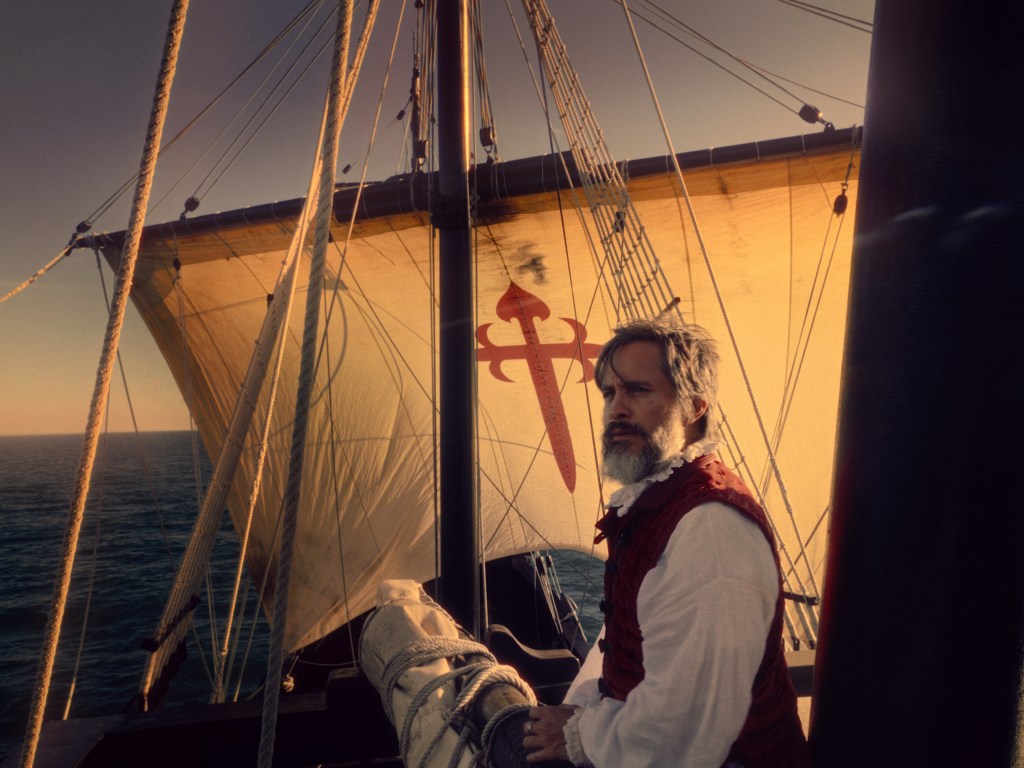
If you ask someone to name an explorer other than Christopher Columbus, there’s a strong possibility many would land on Ferdinand Magellan, famed for his searching of the Northwest Passage, and his attempted circumnavigation of the globe. He never made it around the world and he never found his passage, it existed in the far north, and he and his peers were focused on the slightly more welcoming waters of the South Atlantic, but his resolute determination is something that many learn about in the American Public School system, along with the works of Columbus, Cortez, and Captain James Cook.
Rarely do those discussions go into the nitty gritty of what horrors were being brought to the people who had already discovered these lands that these “explorers” were landing on. Not only were these men often just wrong, but their genocidal tendencies would be felt for generations. Luckily, now we have Director Lav Diaz taking a crack at the bat on explaining the man Ferdinand Magellan, and doing a deep dive on his effects in places like Malacca in Malaysia, and primarily his treatment of the indigenous population of The Philippines.
The film opens with Ferdinand (Gael Garcia Bernal) under the command of Afonso de Albuquerque (Roger Alan Koza) during the seizing of Malacca. After which Magellan purchases a slave that he dubs Enrique (Amado Arjay Babon) and heads home to Portugal. It’s important to note that the style of Director Diaz is one of a patient pace. Lav Diaz is famous for his slow methodical way of telling stories to the point that his style is often referred to as “slow cinema.” Magellan uses this maneuver at every turn. From slow pans of dead Malaccans on the beach, to the meanderings of Spanish soldiers as the wander thru native huts, the movie certainly takes its time. The long tenuous shots are incredibly effective at underling character motivations and foreshadowing what is to come, even if what’s to come won’t happen for a good long while. The film itself is long, but not excruciatingly so, clocking in at two hours and forty minutes, so well Diaz is using his style, he’s also making an effort at being more commercially digestible than some of his earlier fare.
Magellan is broken up into three acts. The first section primarily takes place in Malacca as Magellan and Albuquerque “discover” the Malaysian territory. From there Magellan and the Enrique travel back to Portugal where Magellan meets his wife Beatriz (Angela Azevedo) and before long Magellan is off on his voyage to discover the Northwest Passage and circumnavigate the globe. The second act is the attempted journey around the world. Rather than find the Northwest Passage north of Canada Ferdinand takes a trip around the southern horn of South America. Diaz’s slow cinema mentality emboldens the ennui of a ship at sea. The monotony of being adrift with nothing to do is felt in long shots of the crewmembers freezing as they float closer and closer to the south pole.
Finally, the last act is Magellan’s arrival in The Philippines. He was indeed proving that it was possible for a ship to circumnavigate the globe, even if he never would make it all the way to the end. And the reason that he would never be able to is because of his own treatment of the indigenous people of The Philippines. As Magellan attempts to ingratiate himself to the land that he “discovered” and the peoples of the island resist any charm he might have, a small war breaks out between Magellan’s men and the people of the isle of Mactan. Anyone who has studied history knows that Magellan never makes it off the island of Mactan, but the image of Filipino warriors celebrating around a fire and carrying Magellan’s headless corpse feels like a cleansing for the countless indigenous deaths this man was responsible for. It’s impossible to not crack a smile seeing his demise, knowing this victory was hard fought by a tribe of people who were unceremoniously interrupted by a man coming into the only home they knew and attempting to colonize them. The story of The Philippines does sadly end in many colonization, but this story ends with a rare victory for a small island nation.
Magellan is not the fun boat adventure of Master & Commander: The Far Side of the World, but it has much of the same DNA. It’s not a feel good movie about having a grand old time with your boys on a ship. But the stunning shots of the galleons on the open water will scratch a little bit of that itch, and the performances by Gael Garcia Bernal and particularly the performance of Amado Arjay Babon sell a story of a 16th century explorer in exactly the lens it needs to be seen.
4.5/5
 The Joey Awards
One response to “‘Magellan’ is a zoomed in dissection of the explorer, and the devastating effect he had on the indigenous people that he came into contact with”
Over the Edge of the World is a non-fiction about Magellan’s circumnavigation and I can’t recommend it highly enough. Great companion piece to this that I look forward to seeing!
LikeLiked by 1 person