
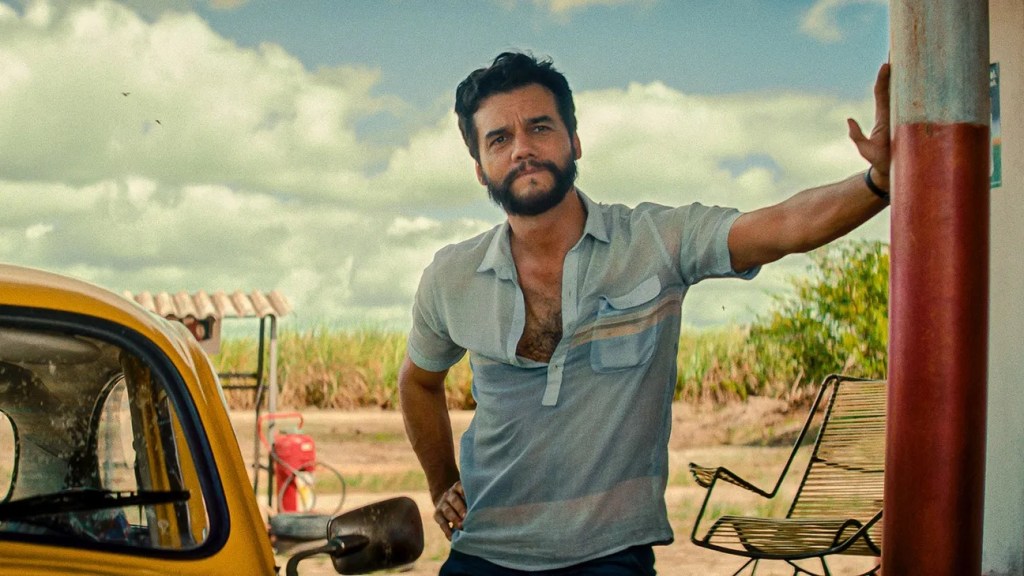
As anyone in America in 2026 can tell you, navigating a fascist regime is a stressful activity. You wouldn’t know it watching Armando (Wagner Moura) as he enters the scene in a bright yellow VW Bug. Pulling up to a gas station on his way into Recife before Carnival begins he talks casually to the owner of the gas station as two armed officers come up to harass him. They ask for his papers, tell him it’s in his best interest to give them a charitable donation, check his fire extinguisher in the vehicle, and are generally rude during the whole of the interaction. Armando doesn’t miss a beat, in a Bondesque maneuver he manages to satiate the cops of the ruling military dictatorship and proceed on his way to the city with only a few cigarettes less than what he had.
Armando’s mission is to get himself and his son Fernando out of the country before the military dictatorship can track him down. He is no spy though, he is simply a leftist professor on the run from the government that seeks to destroy him and his ideology. The pace of the film shows off not only his calm demeanor in the face of danger, but also highlights the lives of the ones that inhabit the country of Brazil during these times. Giving space for the movie to breathe allows us to get to know not only Armando and his son, but the rest of the cast of characters taking refuge in the city of Recife. From landlady Dona Sebastiano (Tânia Maria), to Angola refugees Thereza Victoria and Arlindo, the film is sure to give these background characters agency, an agency that many portrayals of war torn territories are rare to receive.
Armando must avoid capture by both local police, as well as a couple of hitmen from Sao Paulo who have been set on him by a Brazilian businessman. He adopts an alias and begins working at the government building in the city as Carnival winds down. We see first hand the corruption of the local police as Chief Euclides (Robério Diógenes) and his sons torment an old German tailor. Euclides is enjoying the power that the dictatorship has given him and flaunts it loudly for all to see. Meanwhile Armando is working with Brazilian resistance fighters and giving them evidence of the corruption he saw as a professor.
The film is fairly plotty, working hard to sketch out how the Brazilian people were living during these chaotic times. It feels not too dissimilar from last year’s Brazilian entry in the awards race I’m Still Here. Initially it has much of the same straight forward recounting, but as the movie progresses we are treated to flash forwards of students in 2025 leafing through historical records of Armando’s time in Recife. So while the movie is juggling these timelines things get a little headier. It will jump from flash back to flash forward and back without much explanation. Watching it feels at time like a dream that the needle has skipped a beat of. A feeling I’m sure that people living under the dictatorship feel to this day.
Wagner Moura is a stand out in the film, putting on as graceful a James Bond performance as one could imagine. The film is bulky and gnarled, not as friendly as some historical dramas, but still as compelling as any you’re likely to see. There is just so much stuffed into the film, from the flash forwards, to a tale of a disembodied leg attacking people, to a shark dissection, it becomes difficult to hold it all in your head. But the ride is absolutely thrilling all the same, and while it can be overbearing to try to comprehend every detail of it, even to attempt is a worthy use of one’s time.
4/5
 The Joey Awards