
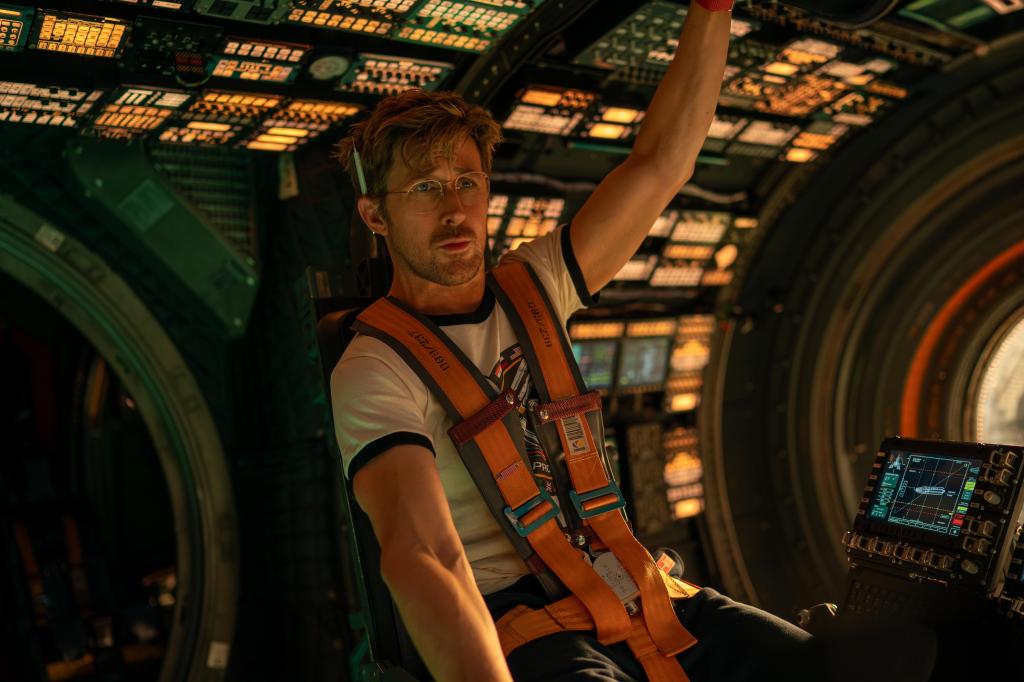
At the outset Project Hail Mary the novel seems nigh impossible to translate to the silver screen. There is often a single character on screen, the thrust of the story telling is developed by his internal monologue, not to mention the budget for a non IP for the space epic would be tremendous. And yet Directors Phil Lord and Chris Miller have proved that it can be done, and done incredibly well with their Ryan Gosling starring film adaption of the same name.
The Gosling character, Ryland Grace, has been shot into space on a last ditch effort to save our sun from dying due to infection by interstellar parasite called astrophage. Along the way he solves problems in the Weiresque way that we’ve seen in The Martian, albeit some of the science in Project Hail Mary is more backburnered than it was in the former. Lord & Miller yadayada their way through some of the more technical aspects of space travel whereas Ridley Scott made it the focal point of the picture. It’s not that they’ve left it behind, they simply have a different main theme than that of Weir’s works, and that star is the alien friend that Ryland Grace meets on his journey, a five limbed rock spider that our protagonist appropriately titles “Rocky”.
There was a solid amount of griping when the marketing for the film “spoiled” the appearance of our bouldery buddy. But watching the film it’s impossible to imagine any kind of marketing without Rocky. He is as much a leading man as Gosling is. Marketing without Rockey would be like marketing Avengers without Ironman, Jurassic Park without dinosaurs, or The Dark Knight without Joker. The relationship that Ryland and Rocky form is the centerpiece of the film, it’s perhaps slightly different than the novel which has the science and the journey at the center which is why people were surprised at the giving up the ghost of the pebbly pal. It’s also important to note that Rocky is primarily a puppet, a design choice that feels at one with the nostalgic nature of the film. Puppetry is a piece of what made many of the great sci fi epics of the 80s and 90s, and with the “friendly alien” storyline it hearkens back to E.T. in both style and story.
There are twists and turns, even without the reveal of Rocky to be sure. Ryland, a public school teacher, is an unlikely recruit for interstellar travel and due to the amnesia he’s experiencing during the film is unsure of why he was selected at all. He is perhaps, a little too everyman than most of our modern protagonists, but even that fits into this film than it would many others. He quickly remembers that he was initially brought in due to a paper he wrote that questioned many of the basic facts about how life starts, but all the details that led to him being alone on a rocket ship headed to a strange star lightyears away are lost to him. We go back and forth through Ryland’s memories with him as he slowly remembers what he’s doing in space and how he needs to accomplish it.
This picture is an unflinchingly hopeful movie. When the sun is discovered to be dying, the nations of the world quickly band together and give Eva Stratt (Sandra Huller) carte blanche to recruit and spend as she sees fit to save the planet. Her team of astronauts and scientists largely put differences aside and get to work immediately, pooling resources, knowledge, and people in order to stop the worse from happening. It’s the kind of collaboration that is so competent and earnest it can only exist in fiction, seeing how seriously actual climate crises are taken in our world.
Project Hail Mary is a feast for the eyes, ears, and hearts. James Ortiz puppetry and voice performance as Rocky is a scene stealing performance for the ages, and Gosling holds the camera as well as any A lister could hope to. The visual effects that Lord and Miller bring to the table elevate the craft of the film, and while it maybe occasionally speedruns some of the science that makes the novel, the focus on connection is more a part of storytelling than perhaps any other facet.
4/5
 The Joey Awards