
Paul Thomas Anderson is not the first person that one thinks of when listing off political directors. Spike Lee, Clint Eastwood, Oliver Stone, Katheryn Bigelow, and Aaron Sorkin are more the type to tackle American politics head on. PTA’s body of work is much more akin to quiet movies about strange relationships, masterfully told with A plus acting alongside clever and quirky screenwriting. The thing that is the most surprising about his newest venture, One Battle After Another, is not that he manages to create from whole cloth one of the most succinct rundowns of modern day American politics. No, the most surprising thing is he does that while staying true to form and ensuring that every beat of the film still feels like a Paul Thomas Anderson movie.
The film is a plotty one, especially by Anderson standards. Going through it beat by beat would pull the rug out of the journey the film takes the viewer on. Suffice it to say the movie follows a revolutionary by the names of Bob Ferguson (Leonardo DiCaprio) and his daughter Willa (Chase Infiniti), and their desperate efforts to evade capture by US Colonel Steven Lockjaw (Sean Penn). Bob and his former partner Perfidia Beverly Hills (Teyana Taylor) were a part of a leftist revolutionary group. We see them assaulting a migrant detention facility in California at the beginning of the film. As the intro unfurls Perfidia gets pregnant, but once her daughter is born she decides that family life is not for her and leaves Bob and Willa to fend for themselves.
The film is such an accurate approximation of our times it’s staggering this is a project that has been rolling around PTAs head for twenty years. From the migrant detention facilities, to the far right’s response to any kind of resistance from the left, each turn the story takes feels like it was written last week. As we zoom in on Bob and Willa’s life in the sanctuary city they’ve escaped to, Baktan Cross, we see Bob wrestling with how much rebellion to continue to do himself, and how much to let his daughter in on. How much safety is there in teaching your children about the fascist forces rising up in the ranks of the federal government? Can he himself keep tabs on the revolution from outside? Is it worth it to have a fight with the school system on what exactly kind of American History they’re teaching? The exhaustion that’s felt about every battle that Bob Ferguson has fought up to this point is shown across Leo’s performance, which is quite possibly the very best of his career.
Sean Penn is also incredible in his role as an impossibly racist military commander. His dogged pursuit of Bob and Willa is spurred on by the fact that early in the film his embarrassed, both professionally and sexually by Perfidia. After this opening sequence we see Lockjaw developing a sexual fetish surrounding Perfidia. The glaring racism of fetish is shone brightly throughout the movie, contrasting it against Bob’s love of Perfidia as a person, as opposed to the obsession with her race that Lockjaw has devloped. In a tense moment Lockjaw approaches Bob in a grocery store asking him about his daughter, “Sounds like a black girl’s name, do you like black girls?” He mutters intensely, almost to himself. “I LOVE THEM!” He growls and quickly runs away, his racism keeping him disgusted with himself for admitting it.
We later learn that Lockjaw is close to gaining entrance into a secret higher order of far right extremists. A group that prides itself on its purity and whiteness and calls themselves, hilariously, The Christmas Adventurers. A group of older white men that sit in a room and wring their hands, concerned about some coming great replacement should white people not procreate enough. Of course this only counts if their children are white. Blood lines are only important in their eyes if the children look like them. In a stroke of brilliant casting all the men in this room seem approachable and level headed, before they start talking about their feelings towards any non whites. One of them sports a Patagonia vest, another a LaCoste polo, the standard wardrobe of your average suburbanite American father. Racist movements like this can’t function without the middle of America being bought into them after all, and it feels like they’re winning more and more every day.
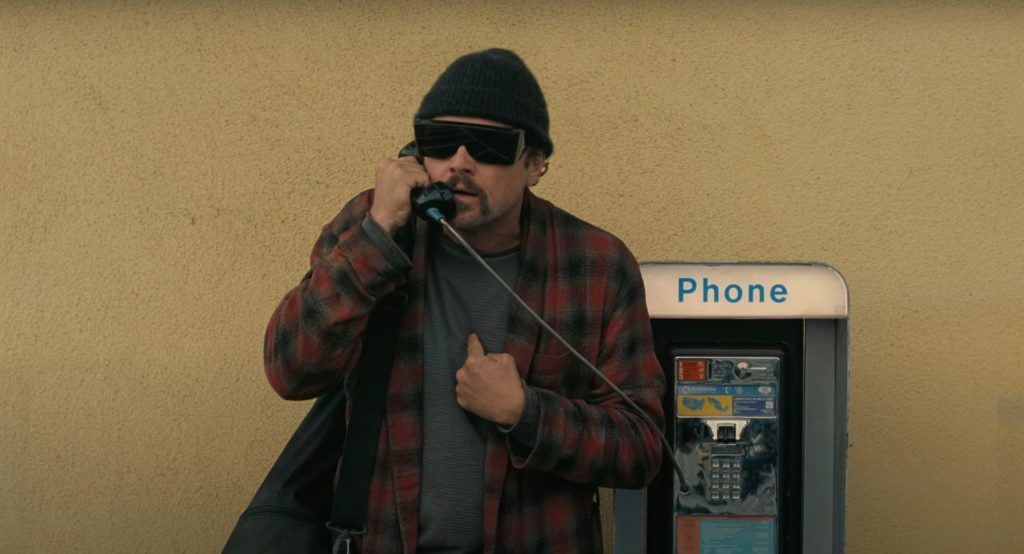
The pacing of the film is equally brilliant as the writing. Bob navigating alleys and rooftops, trying to avoid the catastrophe brought down upon Baktan Cross by Colonel Lockjaw. The protests that erupt when agents start pulling people off the streets are standard these days, and the tactics used by the police force to use whatever level of force they deem fit are equally familiar. “Send in Eddie Van Halen” says one cop to another, and a disguised protestor exits a van and throws a molotov cocktail at the police force, ensuring them the ability to “defend themselves” from the threat they created. But even as these horrors are being unveiled Leo’s performance as Bob, who operates as both a dangerous revolutionary and a dopey dad stuns every time he’s on screen. From him getting teargassed and having to hide his bloodshot eyes with visor sunglasses, to nervously following some skateboarders leading him to safety across the rooftops are brilliant slapstick comedy that work impossibly well with the other heavy themes of the film.
It’s a long film, clocking in at two hours and fifty minutes, but at no point will you be bored or hoping that credits will roll soon. Each step is an escalation, from the prologue, to the protests, to quite possibly the single greatest chase scene in American Cinema. I love the Fast & Furious franchise, but neither of it’s two best directors Justin Lin or James Wan could’ve pulled off what PTA does with a hilly highway towards the end of this picture. It’s a one of a kind movie and you would be remiss to not see it in theaters.
5/5
 The Joey Awards
2 responses to “In the movie of the year, Paul Thomas Anderson’s ‘One Battle After Another’ tells a story of modern America so perfectly it feels like it was ripped out of yesterday’s headlines”
¡VIVA LA REVOLUCION!
LikeLiked by 1 person
10/10, totally agree but I can’t believe you got thru this whole review without mentioning the brilliant and *perfect* Benecio del Toro!
LikeLiked by 1 person