
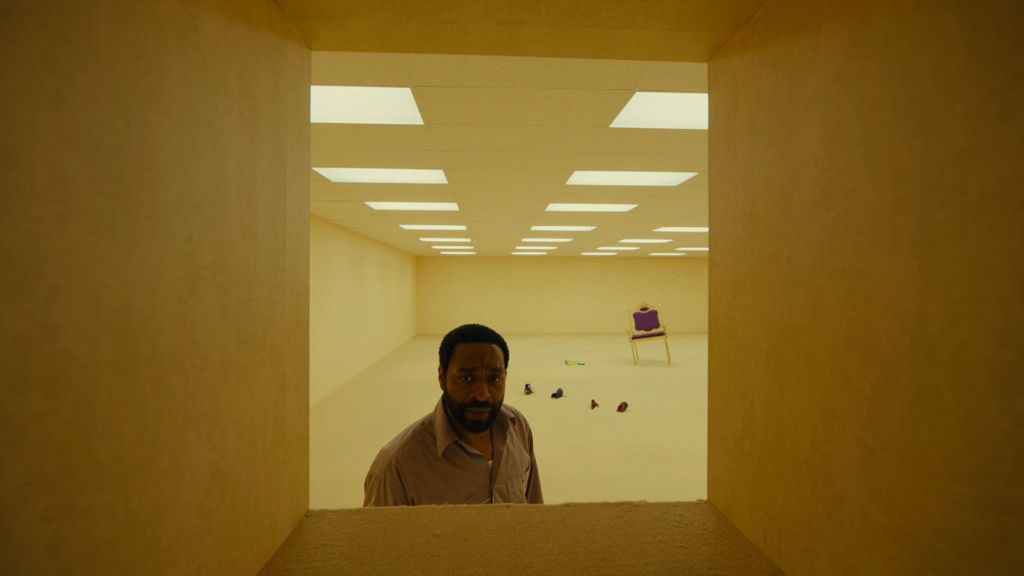
The current state of the world we’re living, it’s not that surprising to find ourselves in some these “liminal spaces” that the internet has become obsessed with over the past few years. An empty mall, an office building after hours, I remember getting out of whatever extra curricular activity I had in high school and wandering the dimly lit hallways of my school. These in-between areas are becoming more common, not less, as buildings are abandoned, physical shops close down in lieu of online retail, and people spend less and less time in third spaces. These abandoned structures feel like a space that the world simply forgot, and only remembers in a haphazard way in the unexpected event that somebody wanders into them by accident.
That’s the conceit of Backrooms a new film by a young up and coming director Kane Parsons. Based on a web series (that was originally based on a meme) of the same name that Parsons created during the COVID-19 Pandemic when he was a mere 14, it’s now a major motion picture produced by A24 and starring two Academy Award Nominees, Chiwetel Ejiofor and Renate Reinsve. It’s the kind of team up that only A24 would be brave enough to bring about, pairing that kind of performer with a 20 year old freshman director. It’s safe to say at this point that it worked out on an unprecedented level.
Backrooms follows a down on his luck furniture salesman named Clark (Chiwetel Ejiofor). A man who is barely holding himself together, and whose life has spiraled completely out of control due to alcohol abuse that destroyed his marriage. He explains exactly how his marriage fell apart to his therapist Mary (Renate Reinsve), who is not without her own baggage, in a rather intense session with her. Later that night Clark is sleeping at his store having been kicked out of his own apartment and accidentally wanders into an extra dimensional liminal space. It’s comprised of rooms that don’t make sense, every room covered in the same sickly yellow wallpaper, with dim fluorescent lights buzzing overhead. The plot of Backrooms is not the main event, this is. Long steady shots of nonsense rooms that trigger a kind of nostalgia that makes one feel nauseous. Clark is fascinated by this world he can escape to, and brings a couple of his minimum wage employees to dive into the monotone realm. Not unlike the Mark Z. Danielewski book House of Leaves, the further they explore the bigger The Backrooms become. As they dive further and further in they realize that they are not the only ones wandering the ochre halls.
The whole project feels so original as Clark and Mary trauma dump on one another, sitting around a dinner table in a room that feels just familiar enough to be unsettling. The uncanny valley amps up the dread you experience as you gaze down a hallway, or look down a random shaft in the middle of the floor, or notice a Christmas Tree that is the only light source in an otherwise empty chamber. Backrooms at once feels familiar and so foreign, the movie describes a couple times that The Backrooms themselves are like if you were to describe a dog to someone who has never seen a dog before, and ask them to draw it.
This broken world being buried under our own is the part of The Backrooms that’s the most familiar. We are now at a point where late stage capitalism was always going to end up, as these structures and concepts that were once so hallowed lie dormant in the backs of our minds. It’s comforting to spend time in the them in the same way it’s comforting to never go outside, never have to grow, never have to change. That’s the world that was promised to us in florescent lit office buildings, and raucous shopping malls. If we can sneak back into those spaces and tell ourselves that all those lies are true, then why would we ever want to escape? And that’s the most frightening concept that Backrooms brings to the forefront.
4/5


One response to “‘Backrooms’ steeps us in nostalgia for a broken world, and leverages two Academy Award Nominees to unpack our feelings about it”
[…] A decision that they’re surely regretting after getting body slammed by Obsession and Backrooms last weekend at the box […]
LikeLike