
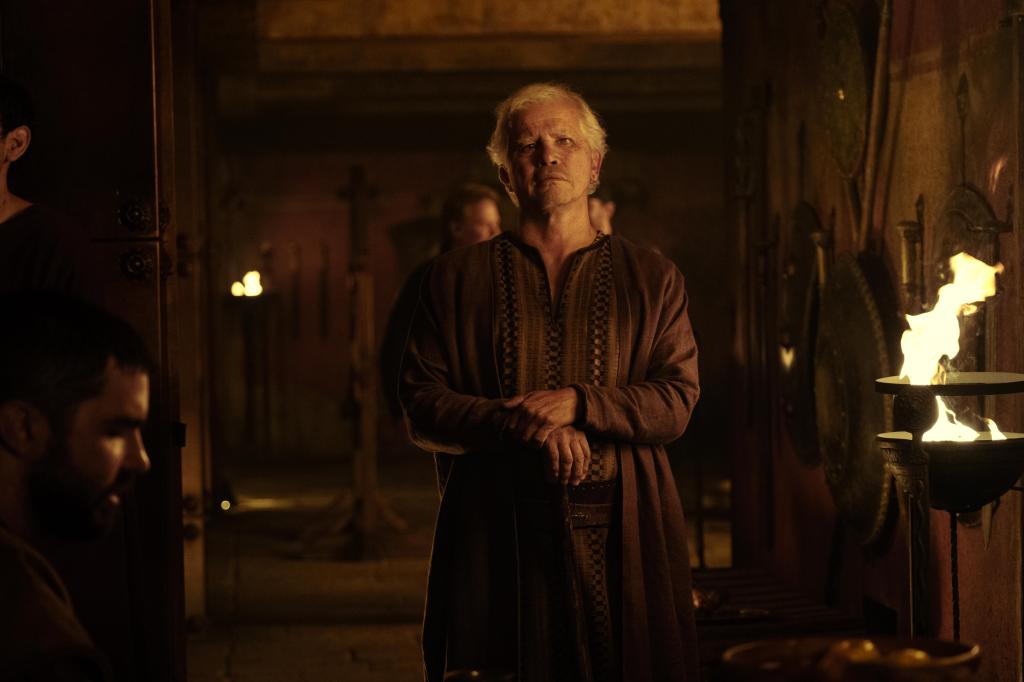
Christopher Nolan has firmly solidified himself as the most successful film maker of this generation. There is simply no other way around it. He has found success with nearly every project he has brought to the screen, from superheroes and magicians, to dream thieves and sci-fi epics, war films, and historical biopics. Just about every film he has created has been a commercial and critical success. He has now taken a swing at one of the great stories of humanity, the three thousand year old Homerian poem, The Odyssey. He is perhaps the only person who could get a project of this size off the ground, and certainly the only person who could get the backing to make this film the way he did. Filmed 100% on IMAX cameras, while using as minimal CGI as humanly possible, it is a phenomenon of film making craft even if everything else about the movie had turned up a complete failure.
Director Nolan often returns to similar themes in his film. He is obsessed with the idea of controlling time, so much so that many chalk up his framing of films like Dunkirk or Inception as gimmicky. And perhaps for a time it became too cute of a trick for him to fiddle with. In The Odyssey there’s not so much time dilation, as there is as a brokered sequence of events. The first two thirds present themselves as a series of one character telling another character a story. A fitting device for a poem that was passed down through oration for much of its beginning. Whether it’s Odysseus (Matt Damon) himself explaining to Calypso (Charlize Theron) what he remembers of his journey, or Menelaus (Jon Bernthal) telling Telemachus (Tom Holland) about what it was like inside The Trojan Horse, we witness the telling of countless stories over the runtime of The Odyssey.
As Odysseus explains how things ended after the breaking of Troy, we see him begin his voyage home. He seems disaffected and sullen as he and his men pillage villages for supplies, attempt to steal cheese from a cyclops, and are run off by giants. They often speak of Zeus’ Law, the idea that one should be kind to strangers, lest they be a god in disguise. That these people should be welcoming them wherever they go, regardless of how they comport themselves. At one point Odysseus’s second in command asks a woman “Why are you afraid of us? We are Greeks!” As if it matters what kind of pillager one is when someone approaches your home with the intent to raid, pillage, or colonize.
Meanwhile Odysseus’s wife Penelope (Anne Hathaway) is attempting to maintain civility whilst her home is infested with suitors hoping to marry her and keep the isle of Ithaca for themselves. The trusty swineherd Eumaeus, who operates as the heart of the film in a lot of ways, (John Leguizamo) attempts to keep suitors like Antinous (Robert Pattinson) in line, but it is becoming more and more difficult to delay choosing a new husband after two decades of waiting. Highlighting again one of Nolan’s chief fears seems to be losing time, as his obsession with controlling it in film highlights. It makes sense that the idea of missing out on two decades of life from his family would be like a siren song to creating this epic.
The look of the film is truly immaculate. Having seen both a standard format, and an IMAX screening it has to be said that the bigger screen really does make each shot in The Odyssey absolutely soar. From Odysseus and his men sailing the wide blue yonder, to warriors emerging from a wooden horse to capture a city, to a herd of grazing cattle on the sun god’s island. It all looks both unbelievably impressive, and unflinchingly classic. A sword and sandals epic from the 1950s made anew for the modern era. The levels Nolan went to avoid CGI are jaw dropping. He used jet skis to create the whirlpool Charybdis, ratchet straps to pull men up practically as Scylla was attacking, forced perspective and seven foot tall performers for the Laestrygonians. It looks like no other film you’ve ever seen. And at the very end of the film, he hits home on a regular theme of a Christopher Nolan film.
The core difference that Nolan highlights with his telling of The Odyssey is that of the Trojan Horse. The grand trick that Odysseus played on the City of Troy, in order to sneak in and win the war. Much like J. Robert Oppenheimer, Odysseus is racked with guilt about the new world he created by breaking a tenant of common decency. It would, after all, be considered a war crime in the current era, to sneak into a city, murder it’s defenders in the dead of night, and put the rest of the city to the flame. And in that guilt we see Nolan’s guilt. Guilt for a world that he and his generation did not take care of, guilt about the way we treat strangers, whether we are visiting or hosting, guilt about his own role in the world we find ourselves.
5/5


One response to “Christopher Nolan uses ‘The Odyssey’ as a cautionary tale; about the mistakes that we make, the ways we treat each other, and the penance we have to pay in the end”
I hadn’t thought of it before you wrote it, but the oral history being presented on screen is a really nice touch and storytelling device.
The Circe sequence was absolutely incredible!
LikeLike