
Lynchian is perhaps a too oft term used to describe films these days. Ever since his passing, the wake left by David Lynch has only continued to grow in expanse. Anytime there’s a dream sequence, or a non sequitur that doesn’t fit neatly into the story structure, anytime you see Kyle MacLachlan even, it feels like people have a penchant to slap the term Lynchian onto a feature. But there does seem like we have a newcomer to the throne that blends cerebral horror with their own personal oeuvre as perfectly as the late David Lynch did it.
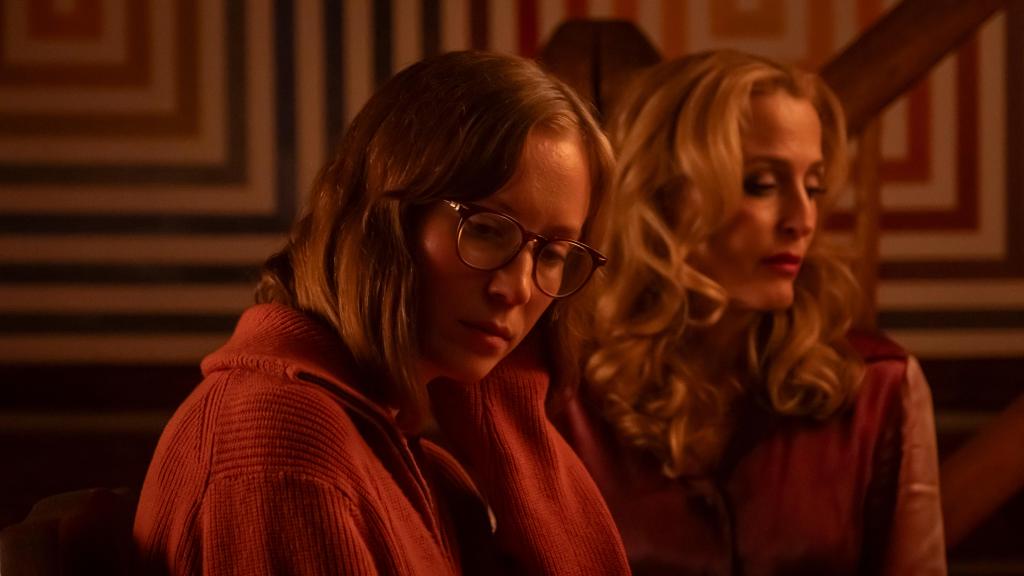
That person is Jane Schoenbrun, a non binary trans director who recently came out with their third feature film Teenage Sex and Death at Camp Miasma, a meta commentary on queer love, the state of the film industry, horror tropes as a story telling crutch, and much, much more. The plot of the film is straight forward enough, an up and coming director Kris (Hannah Einbinder) is hand picked to reignite a long dead in-world horror franchise Camp Miasma. She intends to interview the star of the original Camp Miasma film Billy (Gillian Anderson) and get her to star in the reboot. As the two spend time together you feel the connection they share ooze out of the screen like a bloody geyser. Through the lens of their conversation the film dissects franchise film making, queer love, wokeness, and nostaliga bait in its one hundred and twelve minute runtime.
The title of the film is an obvious homage to the Friday the 13th film series, movies about a hockey masked monster that hacks apart teens at Camp Crystal Lake whenever they start feeling a little too frisky. It’s obviously a love of Schoenbrun’s who treats the subject material with both utter reverence, and a willingness to take to task the more problematic nature of the franchise. Coincidentally Friday the 13th, like Miasma, is a vein of IP that Hollywood has lacked the nerve to mine since 2009 when the remake came out (though there is a TV series slated to come out this year). TSaDaCM discusses Hollywood in inside baseball terms, talking about how Kris is a safe bet for the remake, she’s a queer woman and the Miasma of the world (like much of horror) is historically unkind to the queer community and women. This would not be the first time Hollywood saw an embarrassment of riches in terms of merch, spin offs, tv shows, and the like and tried to hand wave away the problematic aspects to continue to churn a profit.
But TSaDaCM is about more than just Hollywood business dealings. It’s about everything that’s in its title of course. As the tagline says “Blood. Lust.” The movie has many intimate conversations between its two leads about sex. About the way its depicted on screen, but more personally about how terrifying it is to come out and then feel comfortable with another person. Kris talks about how she viewed sex as a distraction for so long, how she was unwilling to enjoy her new found identity because things got in the way or it felt too raw. It feels kismet that recently a movie came out entitled One Night Only in which a dystopian state has banned sex except between married couples. Not only did that film not want to unpack its fascist setting, but Director Will Gluck admitted that he removed the sex scenes from it because audiences are left uncomfortable by them.
Sex, like horror slasher films, is an earnest act. It’s a little cringe to let intimacy show that closely with anyone, let anyone view it on screen in a room full of strangers. But intimacy is good, seeing people become that open with one another is art, and terribly scripted slasher movies are just as cringe. Letting yourself be open for judgement is a brave act, its something the world needs more of. Jane Schoenbrun has made three films that bare their soul to the world in a way that few directors would never dream of. It’s not just the styel of David Lynch, they’ve got the substance of it as well. Teenage Sex and Death at Camp Miasma is a perfect end to what feels like a horror trilogy, all of which have wonderfully rambling titles. It’s not like anything you’ve ever seen before, that much is a guarantee.
5/5
 The Joey Awards