
Dinosaurs weirdly seem like something Hollywood just has a knack for trying and failing to make a movie about. It’s something that audiences certainly have an appetite for, given the continued box office success of the Jurassic Park, now Jurassic World, franchise. And yet each rendition falls flat for both critics and film goers alike. There has been only one truly great dinosaur movie and that was Spielberg’s first attempt at the concept. We are left starved for anything even halfway decent when it comes to on screen appearances by those big bird lizards that first took off in 1993.
Now we have something that feels both familiar and new at the same time, with David Robert Mitchell’s The End of Oak Street. Mitchell, the clever guy he is, couches the prehistoric picture at first in a tale of 80s suburbia that hearkens back to the aforementioned Spielberg sci fi epics of the yesteryear, in a way that feels decidedly fresh. This is a trick we have seen an increasing amount, from JJ Abrams’ Super 8, to The Duffer Brothers’ Netflix series Stranger Things. The key difference here being that this family that appears copacetic in their creation, living a charmed life in the suburbs of Detroit, but underneath it all each one has a secret buried within them they have to face and conquer. It may sound like a trope, but here the characters are given a certain level of darkness, and the film itself is much more perilous than an average family adventure.
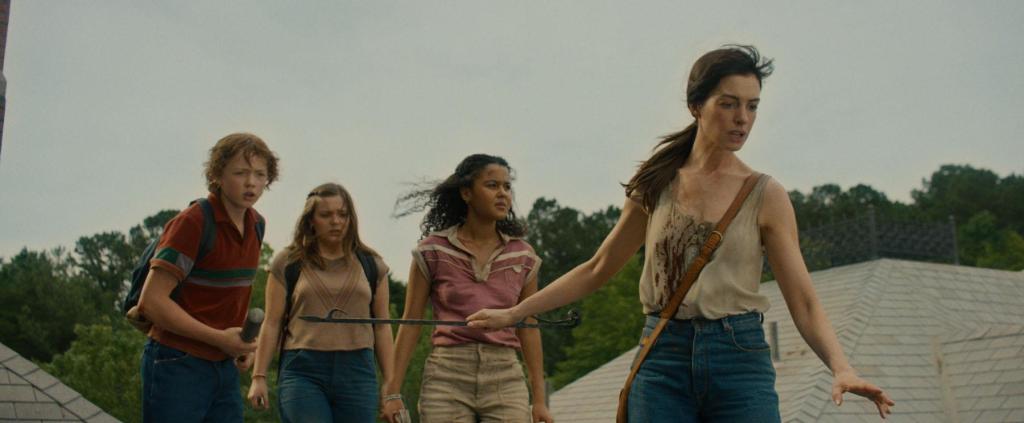
The classic nuclear family is introduced; mother Denise (Anne Hathaway), father Greg (Ewan McGregor), daughter Audrey (Maisy Stella), and brother Brian (Christian Convery). Make up the idyllic Platt family living in the fictional suburb of Flowervale. They have sack races, make snacks for the neighborhood block party, ride around on bikes, and even have a loving dog named Starbuck. Audrey has a deep seeded interest in outer space and astronomy, obsessing over the new television program Cosmos. She’s also lightly coded as queer in a time when coming out was much more frowned upon than it is now, keeping this secret so tight some audience members might miss it. Brian has a bit of a cruel streak to him, having recently broken another child’s arm seemingly for the fun of it. These characters already feel more tortured than the kids of E.T.
The parents are the real stars of the show, Denise is feeling stuck in a way that many women feel in the suburbs. Being suffocated by an aseptic bubble designed to protect from the trauma of anything that can happen out in the world as it actually exists. She writes fiction; stories of a woman leaving her family for the city, something she’s curious about, but would never entertain in real life. It’s a fantasy that she ponders only in written form, a shame that she holds so deeply that she only writes in the basement by herself typing away on her keyboard, hiding her stories from her husband who wouldn’t understand. Meanwhile her husband Greg has been laid off and is delivering pizzas to make a few dollars while he attempts to get a new job. He hasn’t shared this news with any of the family as he manically partakes in the neighborhood fun of suburbia in a futile attempt to keep concerns at bay.
This powder keg of family dysfunction is thrust into a precarious situation when their entire neighborhood is sent back in time to the prehistoric era alongside a various cornucopia of flora and fauna that existed millions of years prior. The family navigates their interpersonal struggles, while at the same time dodging dinos of various shapes and size. Director Mitchell uses his prior expertise of directing horror on It Follows to masterful success as we see a behemoth T-Rex slowly approaching an arguing family, or a massive snake silently slithering into their home. The genre concept of the movie crashes into the idyllic neighborhood like the meteor that would one day wipe out the dinosaurs themselves.
Suburbia is something that David Robert Mitchell has a fascination with, nearly all of his films grapple with the lack of preparedness of life in the cul-de-sac. The ways in which that environment protects, and yet when any amount of pressure is put on it society collapses faster than anyone could expect is a well that Mitchell returns to again and again, and yet always has a new lens or a new story to lay over top of it. The End of Oak Street portrays the rot and the warmth of suburbia in equal parts, and that is the real magic trick of the film. That and lots of crazy dinosaur fun.
4/5
 The Joey Awards